
The Hidden Architecture Behind a High-Performing Divi Website
A beautiful Divi website is only the visible layer. The real difference comes from structure, content hierarchy, performance decisions, SEO planning, mobile behavior, and the systems behind every page.
Good Divi design starts before anything appears on the screen.
Most people judge a website by what they can see.
They notice the colors, imagery, typography, spacing, animations, and overall visual style. Those things matter. They shape first impressions, influence trust, and help determine whether a visitor feels confident enough to keep exploring.
But the strongest websites are not successful only because they look polished.
They work because there is structure underneath the design.
A high-performing Divi website depends on decisions that most visitors never consciously notice. Content hierarchy, mobile behavior, page speed, internal linking, calls to action, SEO structure, reusable design systems, and long-term maintainability all shape how well the website performs after it launches.
That is why professional Divi website design is not just about arranging modules.
It is about building the system behind the experience.
The design visitors see is only one part of the website.
A website can look beautiful and still underperform.
It can have strong photography, modern colors, polished sections, and clean buttons while still failing to guide visitors clearly, rank well in search, load efficiently, or convert attention into action.
That is because visual design is only one layer of a website.
A strong Divi website also needs messaging that explains the business clearly. It needs a user experience that helps visitors move naturally through the page. It needs headings that make sense to both people and search engines. It needs calls to action that appear at the right moments.
It needs performance discipline so the site feels fast and responsive.
It needs mobile layouts that feel intentionally designed, not merely adjusted after the desktop version is complete.
And it needs a structure that can grow over time as the business adds services, content, case studies, landing pages, and SEO resources.
The visible layer matters.
But the architecture underneath determines whether the website continues working after the first impression.
A high-performing Divi website is built in layers.
The best Divi websites do not depend on one impressive hero section or a collection of attractive layouts. They are built from connected layers that work together.
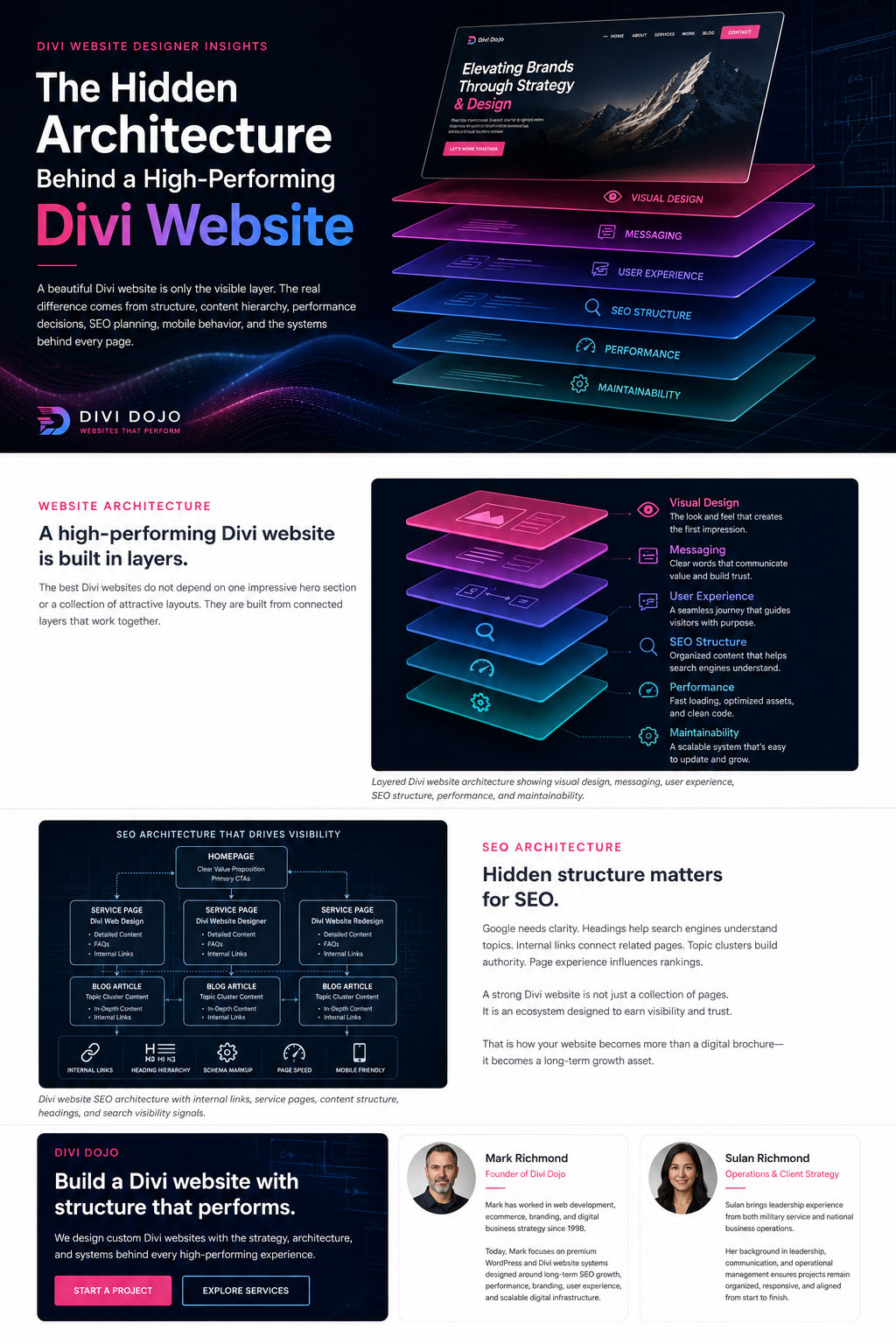
Visual design
The look and feel of the website create the first impression. Color, typography, spacing, imagery, and layout all influence how professional and credible the business feels.
Messaging
Visitors need to understand what the business does, who it serves, why it matters, and what step to take next. Strong design cannot overcome unclear messaging.
User experience
A website should guide visitors naturally from curiosity to confidence. Page flow, section order, navigation, and calls to action all shape that journey.
SEO structure
Search engines need clarity. Headings, internal links, topic clusters, page titles, metadata, and content depth help Google understand what a website deserves to rank for.
Performance
Speed is part of the experience. Image choices, hosting, caching, plugin decisions, script loading, and layout complexity all affect how fast a Divi website feels.
Maintainability
A website should be easy to manage after launch. Reusable sections, global patterns, clear structure, and thoughtful Divi systems help the site stay consistent over time.
Why many Divi websites underperform.
Many Divi websites do not struggle because Divi is incapable.
They struggle because the build process focuses too heavily on appearance and not enough on the structure that supports performance.
A website might use too many modules, oversized images, unnecessary animations, inconsistent spacing, weak heading structure, unclear service pages, or generic calls to action. None of those issues may seem catastrophic on their own.
Together, they create friction.
Visitors hesitate. Pages feel slower. Search engines receive weaker signals. Mobile layouts feel less refined. The site becomes harder to update. The design starts to feel disconnected from the business behind it.
That is the hidden cost of weak architecture.
The website may look finished, but it may not be built to perform.
A Divi website does not perform because it looks good.
It performs because design, content, structure, and strategy are working together.
What a professional Divi Website Designer builds into the system.
A professional Divi Website Designer does more than create attractive sections.
The real work is connecting the visible design to the invisible structure underneath it.
That means thinking through how every page supports the business, how visitors move through the website, how search engines understand the content, how the design scales across devices, and how the website can continue growing after launch.
A strong Divi Web Designer considers the entire ecosystem.
The homepage needs to introduce the brand clearly. Service pages need enough depth to rank and convert. Blog articles and insights should support topical authority. Calls to action should appear at moments of intent. Internal links should help people and search engines move through the site.
Mobile layouts should feel intentional.
Images should support the story without slowing the experience.
The result is a Divi website that feels polished on the surface and organized underneath.
The best Divi websites are designed like systems, not pages.
One of the biggest differences between basic Divi web design and professional Divi website design is how the project is approached.
Typography rules
Headlines, subheadings, body text, captions, labels, and buttons should feel consistent across the website instead of being adjusted randomly from page to page.
Reusable sections
Strong Divi design uses repeatable patterns for service sections, calls to action, proof points, testimonials, feature grids, and content blocks.
Consistent spacing
Premium websites often feel better because of spacing discipline. Margins, padding, section rhythm, and content width all shape the experience.
Conversion paths
A visitor should never wonder what to do next. Strong websites guide people toward contact forms, project inquiries, service pages, or deeper resources naturally.
Internal linking structure
A growing website needs connected content. Service pages, supporting articles, case studies, and FAQs should reinforce one another instead of existing separately.
Scalable page architecture
The website should make it easier to add future content, new services, landing pages, SEO articles, and conversion-focused resources without breaking the design system.
Hidden structure matters for SEO.
Google does not rank a website because it looks beautiful.
Search engines need to understand what a website is about, which pages matter most, how topics connect, and whether the content is useful enough to deserve visibility.
That is why SEO structure matters in Divi website design.
Headings should support the search intent of the page. Service pages should be clear and deep enough to explain what the business offers. Blog content should reinforce the main topics the business wants to rank for. Internal links should connect related pages naturally.
A website trying to rank for terms like Divi Website Designer or Divi Web Designer needs more than one optimized page.
It needs a supporting content ecosystem.
That ecosystem may include service pages, comparison articles, performance insights, website refresh content, Divi-specific guides, case studies, and internal links that help Google understand the relationship between those topics.
This is why design and SEO cannot be separated.
The design determines how people experience the website. The structure helps search engines understand why the website matters.
Visual design gets attention. Architecture keeps the website working.
A polished website may impress someone for a few seconds.
But the deeper structure determines whether that attention becomes trust, movement, inquiry, or growth.
That is especially important for businesses using Divi.
Because Divi makes it easy to create layouts quickly, it can be tempting to think a website is finished once the pages look good. But high-performing Divi websites require more discipline than that.
They need clear sections, purposeful content, strong mobile behavior, clean navigation, SEO-conscious hierarchy, calls to action, performance planning, and long-term scalability.
In other words, the website needs architecture.
Not just decoration.
Divi Dojo designs what visitors see and what performance depends on.
At Divi Dojo, we approach Divi website design as both a visual and structural discipline.
The goal is not just to create a website that looks premium on launch day.
The goal is to create a website that continues supporting the business after launch through better clarity, stronger content structure, improved user experience, SEO-ready architecture, and a scalable design system.
That means every project considers how the brand should feel, how visitors should move, how pages should connect, how search engines interpret the site, and how the business may grow over time.
Because a strong Divi website is not simply assembled.
It is architected.
Need a Divi website built with more than surface-level design?
Divi Dojo helps businesses create custom Divi websites built around branding, performance, SEO, user experience, content architecture, and long-term growth.
If your Divi website looks good but does not generate enough leads, rank well, feel fast, guide visitors clearly, or support where your business is going next, we can help evaluate the structure underneath the design.

Mark Richmond
Founder of Divi DojoMark Richmond has worked in web development, ecommerce, branding, and digital business strategy since 1998.
Today, Mark focuses on premium WordPress and Divi website systems designed around long-term SEO growth, performance optimization, branding, user experience, and scalable digital infrastructure for businesses.

Sulan Richmond
Operations and Client StrategySulan Richmond brings leadership experience from both military service and national business operations.
Her background in leadership, communication, and operational management helps ensure projects remain organized, responsive, and strategically aligned from start to finish.